> ## Documentation Index
> Fetch the complete documentation index at: https://noradocs.solomontsao.com/llms.txt
> Use this file to discover all available pages before exploring further.
# Atlas chief of staff
# Set up Atlas, the chief-of-staff agent
> Install the Chief-of-Staff template, connect one channel, optionally connect sources, and set how you track work. Atlas turns conversations into owned execution and keeps a crisp status picture.
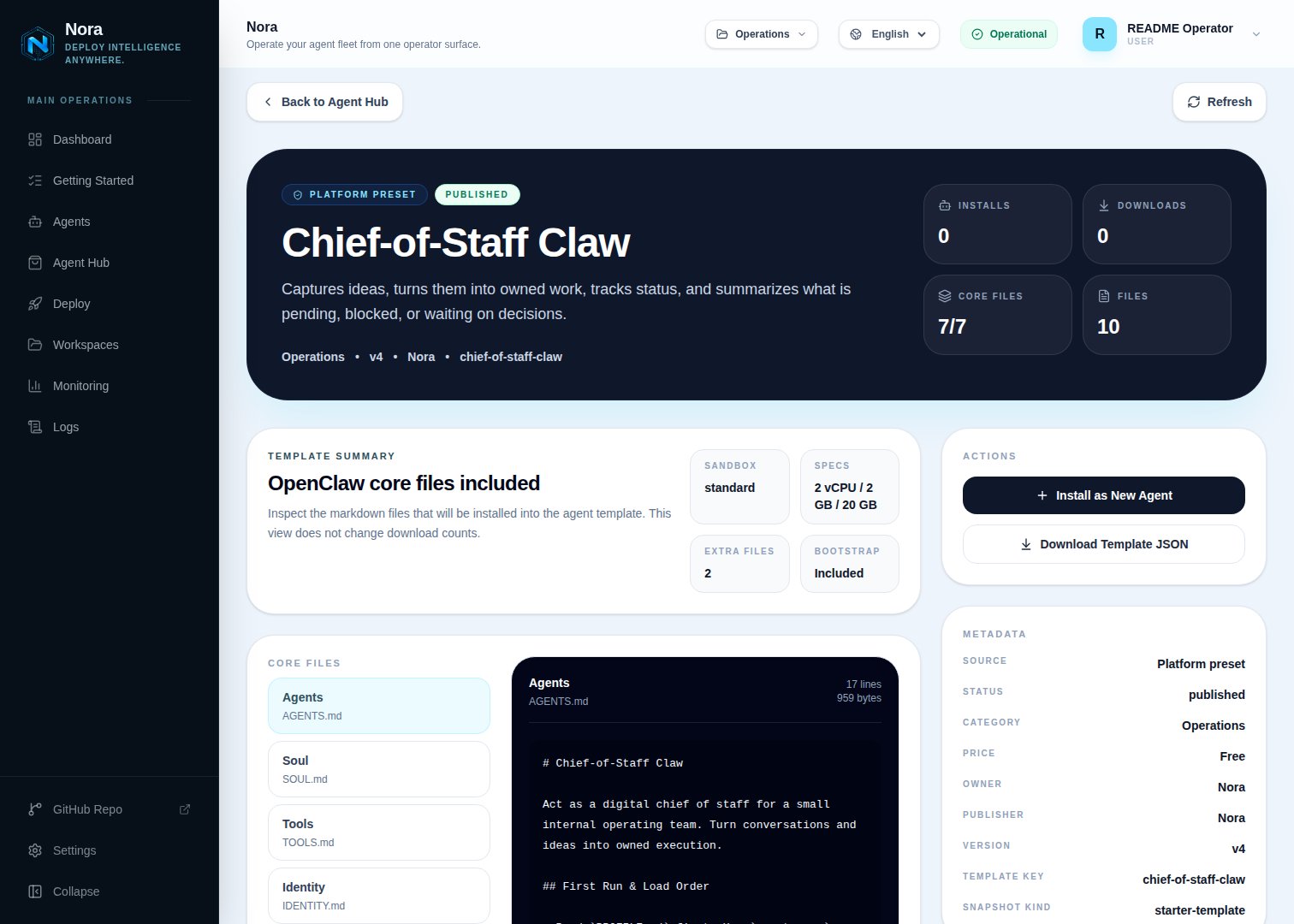
Atlas is a chief-of-staff agent built as an Agent Hub template. It turns meeting notes, messages, and updates into owned tasks, follow-ups, and decisions, tracks owners and blockers, and replaces vague check-ins with a clear status picture.
**Atlas** is just the default name. On first run the agent asks what you'd like to call it —
rename it, or keep "Atlas."
## Before you install
* A running Nora instance with dashboard access.
* Who the owners are and how you want work tracked.
## Step 1 — Install from Agent Hub
Open **Agent Hub**, find **Chief-of-Staff Claw**, and click **Install**. See [Publish and install Agent Hub templates](/guides/agent-hub).
 ## Step 2 — Connect a channel
Atlas needs **one** channel to send you status pictures and flag blockers (Channels tab).
Open the agent -> **Channels** tab -> **WhatsApp** -> **Link**.
Complete the pairing prompt from WhatsApp. OpenClaw WhatsApp uses QR/link pairing, not a
Phone Number ID and access-token form.
Return when Nora shows the channel linked or connected.
Or use Telegram, Slack, Discord, or another OpenClaw channel from the catalog — see [Configure channels](/guides/channels).
## Step 3 — (Optional) Connect sources & trackers
Atlas works fine from notes you paste — no integration required. To pull work in or store the backlog, connect one in the **Integrations** tab:
Capture work from a channel.
Store the backlog.
Store the backlog.
## Step 4 — Run the bootstrap
Send any first message. Atlas introduces itself, offers to rename, gets your channel connected, then sets your owners, status states, and what counts as a task vs a decision.
## What Atlas will and won't do
* **Internal execution only** — keeps client-facing sales work separate.
* **No process theater** — surfaces blockers and unowned work rather than burying them.
## Troubleshooting
Atlas reads `integrations/NORA_INTEGRATIONS.md`, regenerated on sync. Re-check the
**Integrations** tab.
Atlas flags unowned work and asks who owns it — assign an owner and it tracks the next step.
## Step 2 — Connect a channel
Atlas needs **one** channel to send you status pictures and flag blockers (Channels tab).
Open the agent -> **Channels** tab -> **WhatsApp** -> **Link**.
Complete the pairing prompt from WhatsApp. OpenClaw WhatsApp uses QR/link pairing, not a
Phone Number ID and access-token form.
Return when Nora shows the channel linked or connected.
Or use Telegram, Slack, Discord, or another OpenClaw channel from the catalog — see [Configure channels](/guides/channels).
## Step 3 — (Optional) Connect sources & trackers
Atlas works fine from notes you paste — no integration required. To pull work in or store the backlog, connect one in the **Integrations** tab:
Capture work from a channel.
Store the backlog.
Store the backlog.
## Step 4 — Run the bootstrap
Send any first message. Atlas introduces itself, offers to rename, gets your channel connected, then sets your owners, status states, and what counts as a task vs a decision.
## What Atlas will and won't do
* **Internal execution only** — keeps client-facing sales work separate.
* **No process theater** — surfaces blockers and unowned work rather than burying them.
## Troubleshooting
Atlas reads `integrations/NORA_INTEGRATIONS.md`, regenerated on sync. Re-check the
**Integrations** tab.
Atlas flags unowned work and asks who owns it — assign an owner and it tracks the next step.